


WU Min
Collaborator, Mechanobiology Institute, National University of Singapore
dbswum@nus.edu.sg
+65 6601 2310
CBIS Blk S1A, Level 2 Lee Wee Kheng Bldg
National University of Singapore
14 Science Drive 4
Singapore 117557
Laboratory website
Wu Lab Deconstructing the Endocytic Machinery
Research Program
The Cell-Matrix and Cell-Cell Mechanotransduction Group
Affiliations
Department of Biological Sciences, National University of Singapore
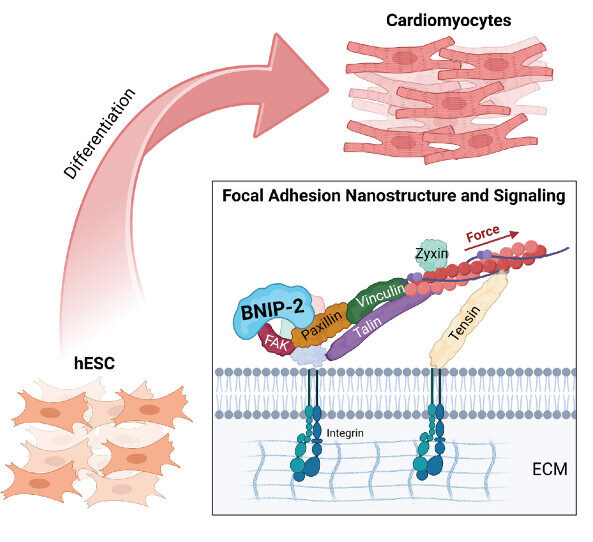
The Nano-Heartbuilder: BNIP-2 Influences Mechanosensing in Cardiomyoblast Differentiation
Researchers from the Low Lab at MBI discover a crucial role for the scaffold protein BNIP-2 in orchestrating focal adhesion dynamics during early heart development, offering new insights into heart regeneration strategies.
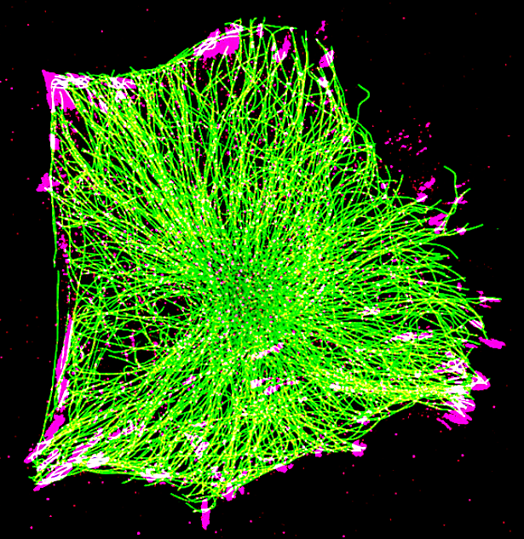
Shedding Light on Local Microtubule Regulation of Focal Adhesions
Researchers from the Bershadsky Lab at MBI utilized optogenetics to unlock the role of microtubules in regulating focal adhesion disassembly, an important step in cell migration. http://www.mbi.nus.edu.sg/featured-research/microtubules-and-cell-movement-a-closer-look-at-focal-adhesion-disassembly
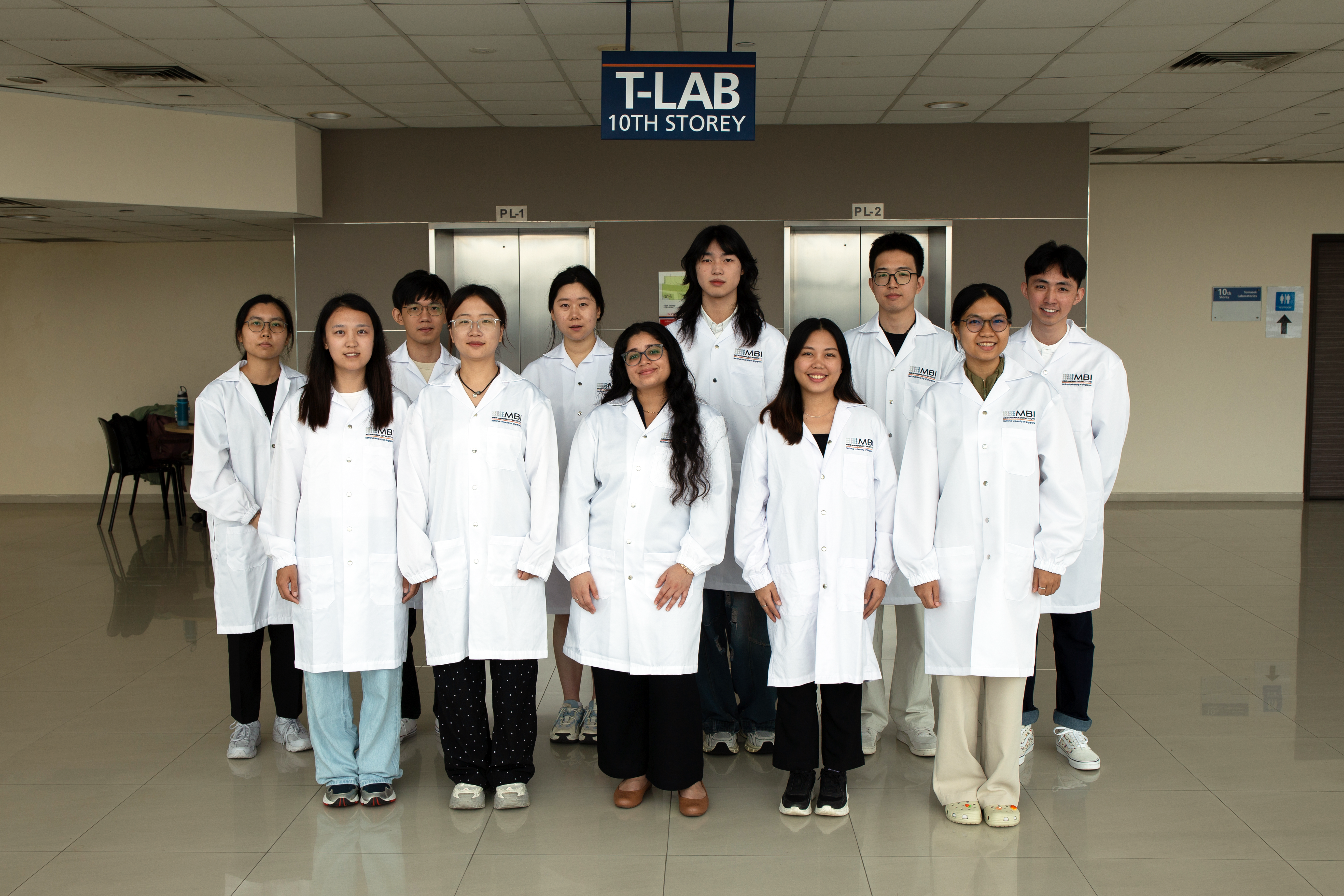
A Warm Welcome to the 2025 Ph.D Cohort!
MBI is delighted to welcome the 2025 cohort of Ph.D students. Coming from a rich tapestry of countries – China, Vietnam, Singapore, India and the Philippines – these eleven outstanding individuals bring with them interdisciplinary expertise and fresh perspectives that will enrich MBI’s vibrant research community.

Neha Paddillaya
Research Fellow, Chan Group

Privita Edwina
Research Fellow
ZHUANG Zirui
PhD Student, Class of August 2025, Li Group
Wu Min
Collaborator
Research Areas
Endocytosis, Membrane traffic, Curvature, Actin cytoskeleton, Mechanotransduction
Research Interests
Dr Wu is interested in elucidating the principles underlying the organization and dynamics of the subcellular membrane compartments. Specifically her lab investigates how biological membranes are shaped through collective protein-lipid interactions and how geometry of the membrane compartment is coupled to cellular functions. The Wu Lab uses a combination of cell biological, biophysical and biochemical approaches to address these questions.
Biography
Dr Wu Min graduated from Peking University in China and received her bachelor degree in Chemistry. She did her graduate studies at Cornell University with Dr Barbara Baird, where she initiated the use of patterned lipid bilayers as antigen-presenting platforms and studied immune cell activation and signal transduction. During her post-doctoral research in the laboratory of Dr Pietro De Camilli at Yale School of Medicine, she focused on the molecular mechanisms of endocytosis. In 2011, she was awarded the NRF fellowship, joining CBIS/MBI in the fall.
Education
PhD Cornell University
Recent Publications
- Xiong D, Tong C, Fung SYS, McClellan S, Yang Y, Yong J, and Wu M. STIM1 and endoplasmic reticulum-plasma membrane contact sites oscillate independently of calcium-induced calcium release. Open Biol 2026; 16(3). [PMID: 41844235]
- Chua XL, Tong CS, Su M, Xǔ XJ, Xiao S, Wu X, and Wu M. Competition and synergy of Arp2/3 and formins in nucleating actin waves. Cell Rep 2024; 43(7):114423. [PMID: 38968072]
- Tong CS, Su M, Sun H, Chua XL, Xiong D, Guo S, Raj R, Ong NWP, Lee AG, Miao Y, and Wu M. Collective dynamics of actin and microtubule and its crosstalk mediated by FHDC1. Front Cell Dev Biol 2024; 11:1261117. [PMID: 38567385]
- Le Chua X, Tong CS, Xǔ XJ, Su M, Xiao S, Wu X, and Wu M. Competition and Synergy of Arp2/3 and Formins in Nucleating Actin Waves. bioRxiv 2023;. [PMID: 37745345]
- Su M, Zhuang Y, Miao X, Zeng Y, Gao W, Zhao W, and Wu M. Comparative Study of Curvature Sensing Mediated by F-BAR and an Intrinsically Disordered Region of FBP17. iScience 2020; 23(11):101712. [PMID: 33205024]
- Chen Y, Yong J, Martínez-Sánchez A, Yang Y, Wu Y, De Camilli P, Fernández-Busnadiego R, and Wu M. Dynamic instability of clathrin assembly provides proofreading control for endocytosis. J. Cell Biol. 2019;. [PMID: 31451612]
- . https://www.ncbi.nlm.nih.gov/pubmed/31390543
- Yong J, Chen Y, and Wu M. Real-Time Monitoring of Clathrin Assembly Kinetics in a Reconstituted System. Methods Mol. Biol. 2018; 1847:177-187. [PMID: 30129017]
- Yang Y, and Wu M. Rhythmicity and waves in the cortex of single cells. Philos. Trans. R. Soc. Lond., B, Biol. Sci. 2018; 373(1747). [PMID: 29632268]
- McPherson PS, and Wu M. Light, space, and time in cancer signaling. Mol. Biol. Cell 2018; 29(6):688. [PMID: 29535172]
Lab Members
Protein Localization
Protein LocalizationIn order for subcellular processes to be carried out within defined compartments or cellular regions, mechanisms must exist to ensure the required protein components are present at the sites and at an adequate concentration. [...]
Actin Filaments
What are actin filaments? Actin filaments (F-actin) are linear polymers of globular actin (G-actin) subunits and occur as microfilaments in the cytoskeleton and as thin filaments, which are part of the contractile apparatus, in [...]
What are the functions of actin filaments?
What are the functions of actin filaments? Several biological processes related to cell shape and movement depend on actin filaments (reviewed in [1]). Some keys functions are: To form the dynamic cytoskeleton, which gives [...]
How do actin filaments act as a force-sensing conduit for both internal and external forces?
How do actin filaments act as a force-sensing conduit for both internal and external forces? Internal forces The orientation of individual actin filaments in the cytoskeleton is a force-driven evolutionary process [1] that contributes [...]
How do actin filaments depolymerize?
How do actin filaments depolymerize? Introduction to Actin Filament Depolymerization Whole cell motility and mechanosensing rely on the continual restructuring of the cytoskeleton, particularly within lamellipodia and filopodia; two dynamic structures that contribute to [...]
What is actin nucleation?
What is actin nucleation? The first step in actin polymerization is known as ‘nucleation’. This step sees the formation of an actin nucleus, which is essentially a complex of three actin monomers, from which [...]
How does Arp2/3-mediate the nucleation of branched filaments?
How does Arp2/3-mediate the nucleation of branched filaments? The Arp2/3 complex is composed of 7 evolutionarily conserved subunits (Arp2, Arp3, ARPC1-C5) that are structurally similar to the barbed end of actin [1]. The complex [...]
How do actin filaments grow?
How do actin filaments grow? Actin Filaments (F-actin) grow from the polymerization of G-actin monomers Actin is a highly abundant (10-100 micromolar on average),~42 kDa structural protein found in all eukaryotic cells (except for [...]
How are actin filaments distributed in cells and tissues?
How are actin filaments distributed in cells and tissues? Actin filaments are widely distributed throughout cells, forming a range of cytoskeletal structures and contributing to an even broader range of processes. Some of the [...]
Actin Crosslinking
Actin Crosslinking Crosslinking of actin filaments is a critical step in cell motility and is a fundamental process in filopodia protrusion and lamellipodia formation. Smaller cross-linking proteins that are more globular (e.g. fascin) [...]
What factors regulate actin filament polymerization?
What factors regulate actin filament polymerization? Nucleation Promoting Factors (NPFs) (e.g. WASP, Scar/WAVE) modulate actin filament nucleation by bringing together actin monomers and pre-existing actin filaments, for example, during filopodial initiation where they recruit [...]
What factors influence actin filament length and treadmilling?
What factors influence actin filament length and treadmilling? Several factors influence actin filament length and treadmilling. ATP binding on G-actin and free ATP-G-actin concentration ATP-binding on actin subunits modulates the dynamics of filament assembly, [...]