


Bibhas ROY
Visiting Research Fellow, Mechanobiology Institute, National University of Singapore, Post-doctoral Fellow, FIRC Institute of Molecular Oncology (IFOM), Italy
mbibr@nus.edu.sg
Level 10 T-Lab
National University of Singapore
5A Engineering Drive 1
Singapore 117411

Hu Jinrong
Research Assistant, PhD Student, Class of August 2019, Li Group, Bershadsky Group

Pulling biomolecular complexes
MBI scientists demonstrate how the phenomenon of force-induced stabilization of biomolecular complexes can be explained on a one-dimensional energy landscape by incorporating defined transition coordinates.
Huang Cheng Kuang
Research Fellow, Lim Group

More twists to the tale: Varied actin patterns in epithelial cells
A recent study led by MBI graduate student Salma Jalal and Senior Research Fellow Tee Yee Han reveals differences in actin organization patterns observed in fibroblasts and epithelial cell subtypes.
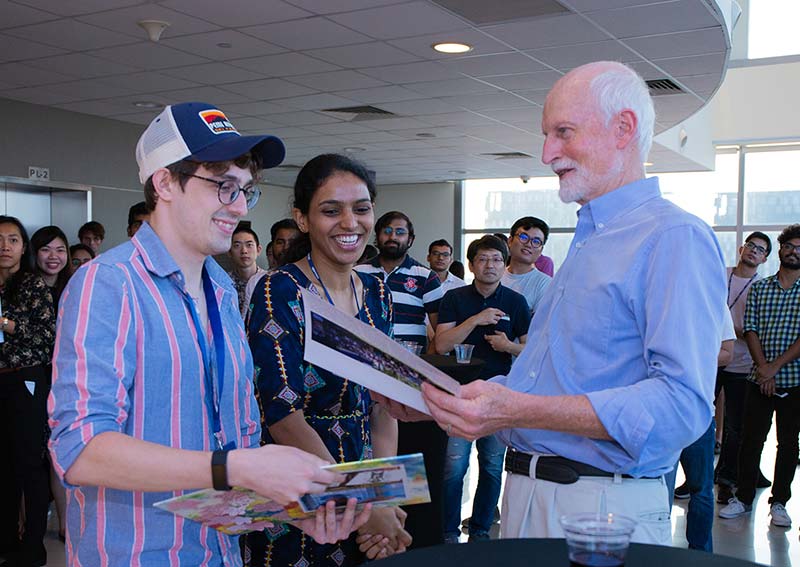
Appreciation evening for MBI’s Founding Director
On Friday 28 June 2019, MBI held an appreciation dinner for Prof. Michael Sheetz to mark his time as Director of MBI. Prof. Sheetz has been MBI Director since its inception, having been recruited by Prof. Hew Choy Leong to lead a new RCE in Mechanobiology in 2008.
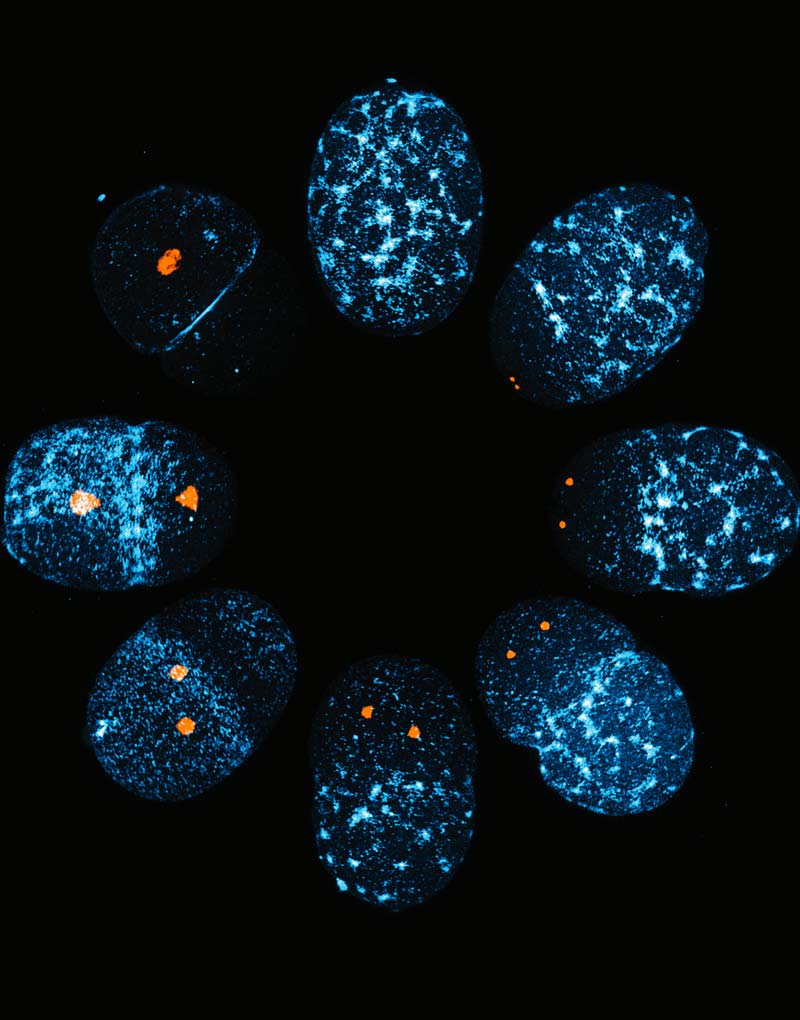
Cell polarity: Aurora over the pole
A recent study led by the Motegi Lab has identified the master switch that triggers the symmetry breaking process in the zygotes of the nematode worm, Caenorhabditis elegans. Learn more
Bibhas Roy
Alumni
I am a Research Fellow in Nuclear Mechanics & Genome Regulation Laboratory at MBI. In my doctoral research at Indian Institute of Technology Kharagpur, I have been understanding about the cellular mechanotransduction which specifically deals with cell membrane mechanosensors and consequent downstream cell responses. Eventually I have quite interested on nuclear mechanotransduction because for last two decades several path breaking findings in cellular mechanobiology has gained enormous interest to scientific community, but the nuclear mechanotransduction field remains quite elusive. This drive brought me to Prof Shivashankar’s Lab at MBI.
During differentiation and also reprogramming, cells accumulated multiple epigenetic changes, which leads to differential type of gene expression in different cell types. My current endeavor explores how nuclear geometry driven epigenetic changes leads to different cell type commitment.
Recent Publications
- Yuan L, Roy B, Ratna P, Uhler C, and Shivashankar GV. Lateral confined growth of cells activates Lef1 dependent pathways to regulate cell-state transitions. Sci Rep 2022; 12(1):17318. [PMID: 36243826]
- Roy B, Yuan L, Lee Y, Bharti A, Mitra A, and Shivashankar GV. Fibroblast rejuvenation by mechanical reprogramming and redifferentiation. Proc. Natl. Acad. Sci. U.S.A. 2020;. [PMID: 32350144]
- Banerjee H, Roy B, Chaudhury K, Srinivasan B, Chakraborty S, and Ren H. Frequency-induced morphology alterations in microconfined biological cells. Med Biol Eng Comput 2018;. [PMID: 30415434]
- Roy B, Venkatachalapathy S, Ratna P, Wang Y, Jokhun DS, Nagarajan M, and Shivashankar GV. Laterally confined growth of cells induces nuclear reprogramming in the absence of exogenous biochemical factors. Proc. Natl. Acad. Sci. U.S.A. 2018;. [PMID: 29735717]