

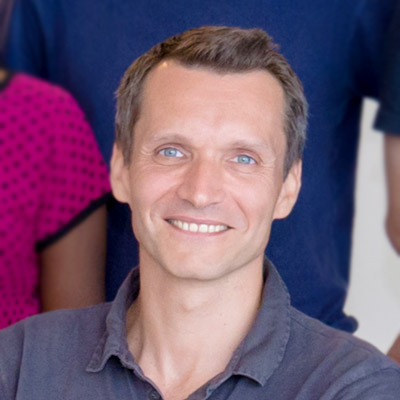
Benoit LADOUX
Visiting Faculty, Mechanobiology Institute, National University of Singapore, Research Director, Université Paris Diderot & Centre National de la Recherche Scientifique (CNRS)
Laboratory website
Cell Adhesion and Mechanics Lab
Research Program
Mechanotransduction in Tissues Group
Affiliations
Research Director, Université Paris Diderot & Centre National de la Recherche Scientifique (CNRS)
What is Fast Endophilin-Mediated Endocytosis (FEME)?
What is Fast Endophilin-Mediated Endocytosis (FEME)? FEME is a novel clathrin-independent endocytic pathway, regulated by the BAR domain protein endophilin, where tubulo-vesicular carriers form within seconds at the plasma membrane upon activation of specific [...]
What is Rho-dependent IL-2 receptor endocytosis?
What is Rho-dependent IL-2 receptor endocytosis? Internalization of transmembrane receptors was thought to occur exclusively via clathrin-mediated endocytosis (CME). However, the discovery of clathrin-independent endocytic routes, in particular, the pathway that mediates the internalization [...]
What is Arf6-associated endocytosis?
What is Arf6-associated endocytosis? Arf6-associated endocytosis is a clathrin-independent, plasma membrane-endosomal recycling pathway, regulated by the Arf6 protein, which is a member of the Arf family of small GTPases [1]. In this pathway, Arf6 [...]
What is the CLIC/GEEC Endocytosis pathway?
What is the CLIC/GEEC Endocytosis pathway? The CLIC/GEEC (CG) pathway is a clathrin-independent endocytic pathway mediated by uncoated tubulovesicular primary carriers called clathrin-independent carriers (CLICs) which arise directly from the plasma membrane and later [...]
How are clathrin-coated vesicles transported?
How are clathrin-coated vesicles transported? Different cytoskeletal networks have been implicated in the transport of clathrin-coated vesicles (CCVs). In yeast, the actin cytoskeleton traffics dissociated CCVs [1], whilst in mammals the microtubule network transports [...]
How are clathrin-coated vesicles uncoated?
How are clathrin-coated vesicles uncoated? Uncoating is the process by which clathrin is removed from clathrin-coated vesicles (CCVs). In mammals, this ATP dependent process is driven by the 70kDa molecular chaperone ‘Heat shock cognate [...]
Benoit Ladoux
Visiting Faculty
Research Areas
Epithelial cell migration; microfabrication for cell mechanics; influence of the mechanical environments on cell functions; mechanotransduction
Research Interests
Our research aims at understanding how living organisms interact with their environment. In particular, we are studying the cooperation between adhesion, biomechanical and biochemical signaling for the adaptation of living organisms to changes in their environment. To probe these questions, our laboratory has developed a repertoire of micro- and nano-fabrication tools to control and measure the chemical and mechanical environment of cells. Our research programme thus focuses on the integration of novel microfabricated devices for the quantitative imaging of living organisms.
Biography
With a background in Physics, Prof Ladoux started his career at Curie Institute working on single molecule biophysics. He worked on two main problems combining statistical physics, microfabrication and molecular biology: 1) chromatin condensation in real time; 2) fluctuations of a single polymer under shear flows. After a post-doc on cell mechanics, he used his knowledge in biophysics and microfabrication to start a new subject on mechanical studies of cell migration and adhesion at the University Paris Diderot. He developed microsystems to characterise the mechanical interactions of cells with their migration support. He is currently working on rigidity sensing, collective cell migration and tissue homeostasis.
Recent Publications
- Shiratsuchi N, Fujita Y, Simon de Beco , Daubech C, Ladoux B, Grata A, Levayer R, Magny E, O'Brien LE, Priya R, Mitchell SJ, Rosenblatt J, Rupprecht J, Stockmann L, Sedzinski J, Roquin L, Suzanne M, Toyama Y, Matekcic M, Trepat X, Vinzens S, Wickström SA, Lwin AKO, and Yap AS. Meeting report - CellExIt#1, the first international symposium on cell extrusion. J Cell Sci 2026; 139(14). [PMID: 42504880]
- Balasubramaniam L, Monfared S, Ardaševa A, Rosse C, Schoenit A, Dang T, Maric C, Hautefeuille M, Kocgozlu L, Chilupuri R, Dubey S, Marangoni E, L Doss B, Chavrier P, Mège R, Doostmohammadi A, and Ladoux B. Dynamic forces shape the survival fate of eliminated cells. Nat Phys 2025;. [PMID: 40636322]
- Kawaue T, Yow I, Pan Y, Le AP, Lou Y, Loberas M, Shagirov M, Teng X, Prost J, Hiraiwa T, Ladoux B, and Toyama Y. Inhomogeneous mechanotransduction defines the spatial pattern of apoptosis-induced compensatory proliferation. Dev Cell 2023;. [PMID: 36800994]
- Sonam S, Balasubramaniam L, Lin S, Ivan YMY, Jaumà IP, Jebane C, Karnat M, Toyama Y, Marcq P, Prost J, Mège R, Rupprecht J, and Ladoux B. Mechanical stress driven by rigidity sensing governs epithelial stability. Nat Phys 2022; 19:132-141. [PMID: 36686215]
- Rose N, Estrada Chavez B, Sonam S, Nguyen T, Grenci G, Bigot A, Muchir A, Ladoux B, Cadot B, Le Grand F, and Trichet L. Bioengineering a miniaturized in vitro 3D myotube contraction monitoring chip to model muscular dystrophies. Biomaterials 2022; 293:121935. [PMID: 36584444]
- . https://www.ncbi.nlm.nih.gov/pubmed/36103541
- Yang Y, Nguyen E, Sankara Narayana GHN, Heuzé M, Fu C, Yu H, Mège R, Ladoux B, and Sheetz MP. Local contractions regulate E-cadherin rigidity sensing. Sci Adv 2022; 8(4):eabk0387. [PMID: 35089785]
- . https://www.ncbi.nlm.nih.gov/pubmed/33850145
- Latorre E, Kale S, Casares L, Gómez-González M, Uroz M, Valon L, Nair RV, Garreta E, Montserrat N, Del Campo A, Ladoux B, Arroyo M, and Trepat X. Addendum: Active superelasticity in three-dimensional epithelia of controlled shape. Nature 2021;. [PMID: 33846613]
- Balasubramaniam L, Doostmohammadi A, Saw TB, Narayana GHNS, Mueller R, Dang T, Thomas M, Gupta S, Sonam S, Yap AS, Toyama Y, Mège R, Yeomans JM, and Ladoux B. Author Correction: Investigating the nature of active forces in tissues reveals how contractile cells can form extensile monolayers. Nat Mater 2021;. [PMID: 33750921]
Lab Members

Deepika Singh
PhD Student, Class of August 2019, Viasnoff Group

Liu Jingzhun
Research Fellow, Yan Jie Group

Liang Lanfeng
Research Fellow, Class of August 2019, Lim Group

Leong Kim Whye
Research Fellow, Class of August 2019, Chan Group

Kashish Jain
PhD Student, Class of August 2019, Kanchanawong Group, Sheetz Group
Hu Jinrong
Research Assistant, PhD Student, Class of August 2019, Li Group, Bershadsky Group

Pulling biomolecular complexes
MBI scientists demonstrate how the phenomenon of force-induced stabilization of biomolecular complexes can be explained on a one-dimensional energy landscape by incorporating defined transition coordinates.
Huang Cheng Kuang
Research Fellow, Lim Group

More twists to the tale: Varied actin patterns in epithelial cells
A recent study led by MBI graduate student Salma Jalal and Senior Research Fellow Tee Yee Han reveals differences in actin organization patterns observed in fibroblasts and epithelial cell subtypes.
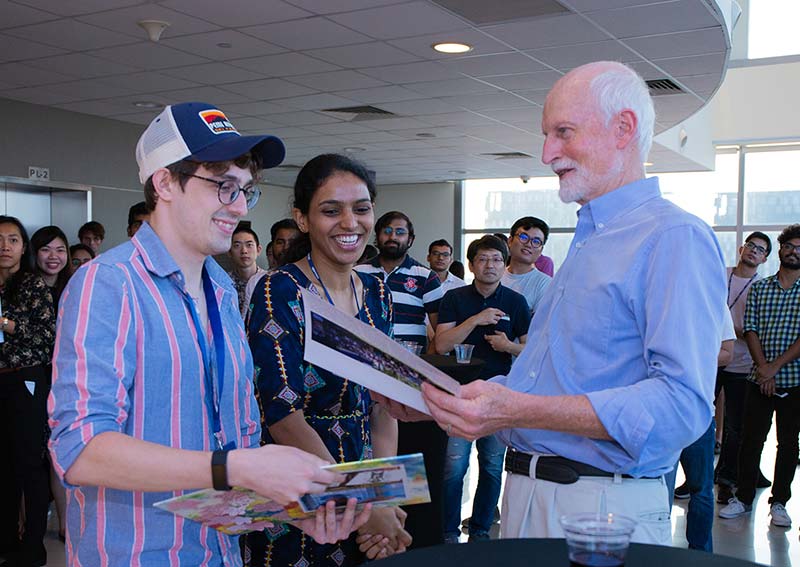
Appreciation evening for MBI’s Founding Director
On Friday 28 June 2019, MBI held an appreciation dinner for Prof. Michael Sheetz to mark his time as Director of MBI. Prof. Sheetz has been MBI Director since its inception, having been recruited by Prof. Hew Choy Leong to lead a new RCE in Mechanobiology in 2008.
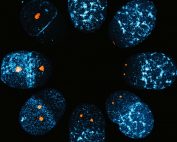
Cell polarity: Aurora over the pole
A recent study led by the Motegi Lab has identified the master switch that triggers the symmetry breaking process in the zygotes of the nematode worm, Caenorhabditis elegans. Learn more
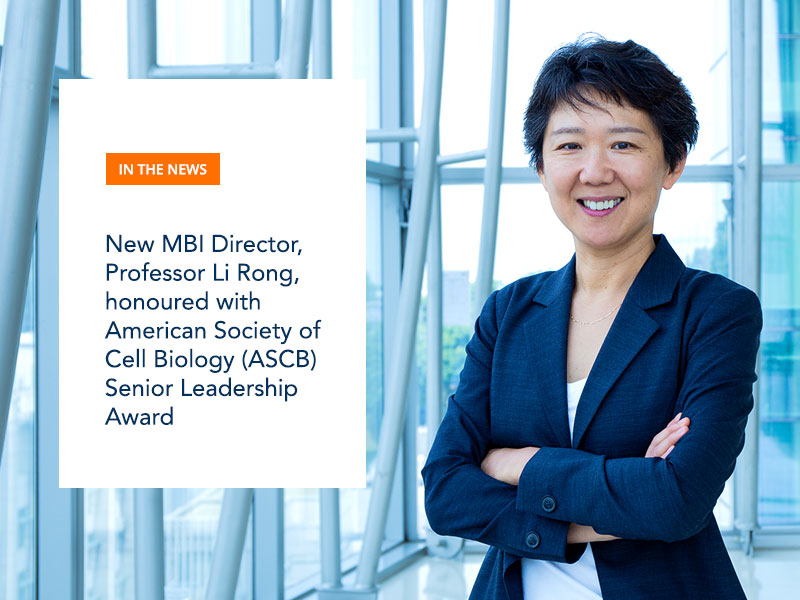
MBI Director honoured with ASCB Senior Leadership Award
MBI Director Prof. Li Rong has been awarded the 2019 Sandra K. Masur Senior Leadership Award from the American Society of Cell Biology (ASCB). This award recognizes cell biology researchers whose “outstanding scientific achievements are coupled with a record of active leadership in mentoring both men and women in scientific careers.”