


GV SHIVASHANKAR
Principal Investigator, Mechanobiology Institute, IFOM-NUS Chair Professor, National University of Singapore
shiva.gvs@gmail.com
+65 6516 2712 ext 62712
Level 10 T-Lab
National University of Singapore
5A Engineering Drive 1
Singapore 117411
Affiliations
Head, IFOM-NUS Joint Research Laboratory, National University of Singapore
Spark-In-Science Program
Spark-in-Science is a non-profit initiative aimed at igniting scientific temper in high school and pre-university students.
In the News
- Today Online: Study to detect cancer before symptoms develop shows promise
- Straits Times: NUS research: Squeezing mature cells to become stem cells
- Channel News Asia: Becoming Human, Episode 2: Unnatural Genius

The Shivashankar Lab is hiring multiple PhD and Postdoctoral positions starting in Jan 2020. Learn more.
How do actin filaments depolymerize?
How do actin filaments depolymerize? Introduction to Actin Filament Depolymerization Whole cell motility and mechanosensing rely on the continual restructuring of the cytoskeleton, particularly within lamellipodia and filopodia; two dynamic structures that contribute to [...]
How are actin filaments distributed in cells and tissues?
How are actin filaments distributed in cells and tissues? Actin filaments are widely distributed throughout cells, forming a range of cytoskeletal structures and contributing to an even broader range of processes. Some of the [...]
How do actin filaments act as a force-sensing conduit for both internal and external forces?
How do actin filaments act as a force-sensing conduit for both internal and external forces? Internal forces The orientation of individual actin filaments in the cytoskeleton is a force-driven evolutionary process [1] that contributes [...]
GV Shivashankar
Principal Investigator (2011-2019)
Research Areas
Nuclear mechanics, 3D chromosome organization, genome regulation, disease diagnostics
Nuclear Mechanogenomics & Cancer Diagnostics Laboratory
Shivashankar’s lab pursues research in understanding the role of cell mechanics on nuclear mechanotransduction and genome regulation.
Extra-cellular micro-environmental signals are transduced to the nucleus to regulate diverse biological processes including cellular differentiation, development and homeostasis; but the underlying mechanisms are still unclear. In this context, how such micro-environmental signals alter nuclear mechanical architecture and how it integrates with the 3D organization of chromosomes and transcription networks are rather unexplored. Using a multidisciplinary approach combining high resolution optical imaging, quantitative single-cell biology, machine learning and functional genomics, our laboratory investigates the principles underlying the coupling between nuclear mechanics and genome regulation. Our recent and ongoing work provides modular links between cellular geometry and nuclear mechanics and its impact on transcription dependent 3D organization of chromosomes and reprogramming. Such modular links define the normal state of cells and are altered during diseases. Hence our studies also have profound impact on developing single-cell nuclear biomechanical markers for early disease diagnosis and therapeutic intervention.
Biography
Shivashankar is a principal investigator at the Mechanobiology Institute, National University of Singapore. His laboratory is focused on understanding the role of cell mechanics on nuclear mechanotransduction and genome regulation in living cells using a multi-disciplinary approach. He carried out his PhD research at the Rockefeller University (1994-1999) and Postdoctoral research at NEC Research Institute, Princeton USA (1999-2000). He started his laboratory at the National Center for Biological Sciences, TIFR- Bangalore, India (2000-2009) before relocating to a tenured faculty position at the National University of Singapore in 2009. He was the Deputy Director of the Mechanobiology Institute (2011-2019). More recently he also heads a joint research laboratory with the FIRC Institute of Molecular Oncology (IFOM), Milan, Italy and was appointed as an IFOM-NUS Chair Professor in 2014. His scientific awards include the Birla Science Prize (2006), the Swarnajayanthi Fellowship (2007), and he was elected to the Indian Academy of Sciences (2010) and to the EMBO membership (2019). He will be relocating to a tenured Full Professorship at ETH Zurich jointly with the Paul Scherrer Institute, Switzerland, to start the Laboratory of Mechano-Genomics in January 2020.
Education
PhD The Rockefeller University, USA
Funding
Mechanobiology Institute, Ministry of Education Tier-3 Co-Investigator Grant & IFOM-MBI Joint Research Laboratory, Singapore.
Recent Publications
- Mitra A, Cutiongco MFA, Burla R, Zeng Y, Na Q, Kong M, Vinod B, Nai MH, Hübner B, Ludwig A, Lim CT, Shivashankar GV, Saggio I, and Zhao W. Acute chromatin decompaction stiffens the nucleus as revealed by nanopillar-induced nuclear deformation in cells. Proc Natl Acad Sci U S A 2025; 122(19):e2416659122. [PMID: 40343993]
- Das R, Sakaue T, Shivashankar GV, Prost J, and Hiraiwa T. Chromatin Remodeling Due to Transient-Link-and-Pass Activity Enhances Subnuclear Dynamics. Phys Rev Lett 2024; 132(5):058401. [PMID: 38364140]
- Jiang K, Lim SB, Xiao J, Jokhun DS, Shang M, Song X, Zhang P, Liang L, Low BC, Shivashankar GV, and Lim CT. Deleterious Mechanical Deformation Selects Mechanoresilient Cancer Cells with Enhanced Proliferation and Chemoresistance. Adv Sci (Weinh) 2023;:e2201663. [PMID: 37218524]
- Das R, Sakaue T, Shivashankar GV, Prost J, and Hiraiwa T. How enzymatic activity is involved in chromatin organization. Elife 2022; 11. [PMID: 36472500]
- Yuan L, Roy B, Ratna P, Uhler C, and Shivashankar GV. Lateral confined growth of cells activates Lef1 dependent pathways to regulate cell-state transitions. Sci Rep 2022; 12(1):17318. [PMID: 36243826]
- Venkatachalapathy S, Sreekumar D, Ratna P, and Shivashankar GV. Actomyosin contractility as a mechanical checkpoint for cell state transitions. Sci Rep 2022; 12(1):16063. [PMID: 36163393]
- Venkatachalapathy S, Jokhun DS, Andhari M, and Shivashankar GV. Single cell imaging-based chromatin biomarkers for tumor progression. Sci Rep 2021; 11(1):23041. [PMID: 34845273]
- Ghanbarzadeh Nodehi S, Shivashankar GV, Prost J, and Mohammad-Rafiee F. The characteristics of nuclear membrane fluctuations in stem cells. J R Soc Interface 2021; 18(176):20201010. [PMID: 33715401]
- Yang KD, Belyaeva A, Venkatachalapathy S, Damodaran K, Katcoff A, Radhakrishnan A, Shivashankar GV, and Uhler C. Multi-domain translation between single-cell imaging and sequencing data using autoencoders. Nat Commun 2021; 12(1):31. [PMID: 33397893]
- Lee Y, and Shivashankar GV. Analysis of transcriptional modules during human fibroblast ageing. Sci Rep 2020; 10(1):19086. [PMID: 33154459]
Lab Members

Deepika Singh
PhD Student, Class of August 2019, Viasnoff Group

Liu Jingzhun
Research Fellow, Yan Jie Group

Liang Lanfeng
Research Fellow, Class of August 2019, Lim Group

Leong Kim Whye
Research Fellow, Class of August 2019, Chan Group

Kashish Jain
PhD Student, Class of August 2019, Kanchanawong Group, Sheetz Group
Hu Jinrong
Research Assistant, PhD Student, Class of August 2019, Li Group, Bershadsky Group

Pulling biomolecular complexes
MBI scientists demonstrate how the phenomenon of force-induced stabilization of biomolecular complexes can be explained on a one-dimensional energy landscape by incorporating defined transition coordinates.
Huang Cheng Kuang
Research Fellow, Lim Group

More twists to the tale: Varied actin patterns in epithelial cells
A recent study led by MBI graduate student Salma Jalal and Senior Research Fellow Tee Yee Han reveals differences in actin organization patterns observed in fibroblasts and epithelial cell subtypes.
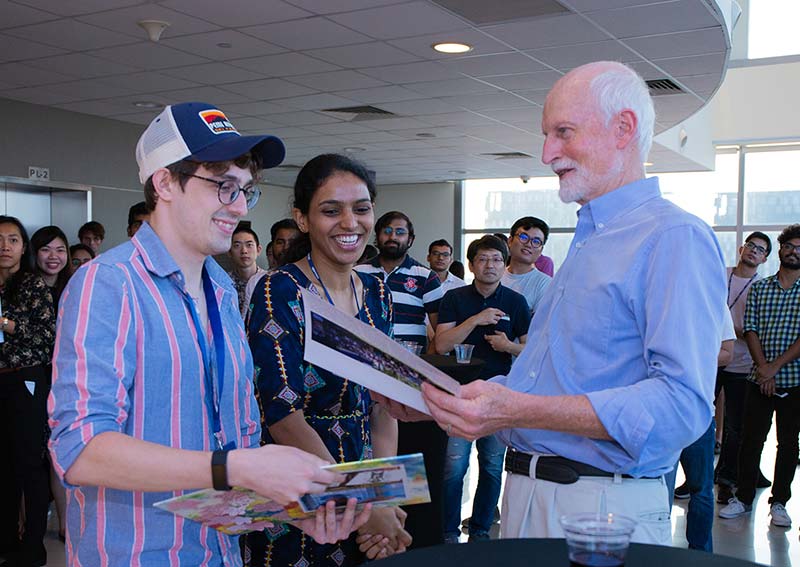
Appreciation evening for MBI’s Founding Director
On Friday 28 June 2019, MBI held an appreciation dinner for Prof. Michael Sheetz to mark his time as Director of MBI. Prof. Sheetz has been MBI Director since its inception, having been recruited by Prof. Hew Choy Leong to lead a new RCE in Mechanobiology in 2008.
Cell polarity: Aurora over the pole
A recent study led by the Motegi Lab has identified the master switch that triggers the symmetry breaking process in the zygotes of the nematode worm, Caenorhabditis elegans. Learn more
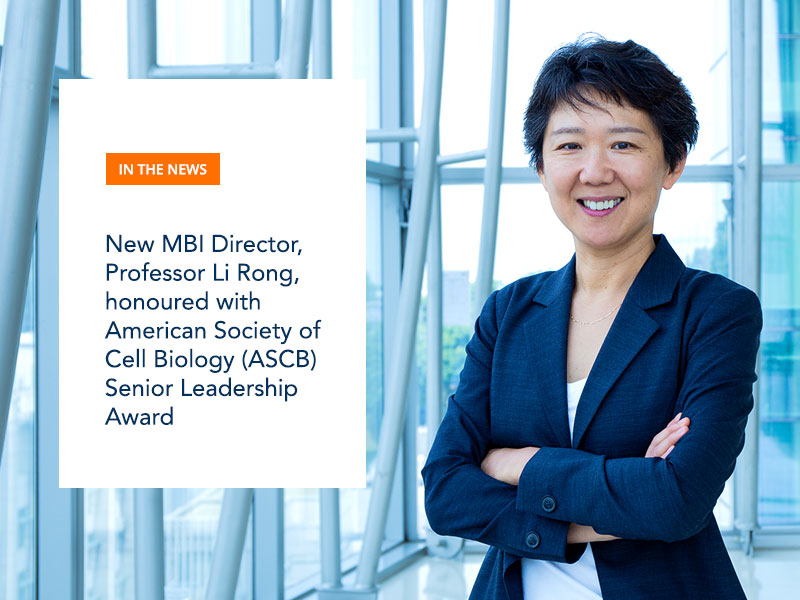
MBI Director honoured with ASCB Senior Leadership Award
MBI Director Prof. Li Rong has been awarded the 2019 Sandra K. Masur Senior Leadership Award from the American Society of Cell Biology (ASCB). This award recognizes cell biology researchers whose “outstanding scientific achievements are coupled with a record of active leadership in mentoring both men and women in scientific careers.”