

Benoit LADOUX
Visiting Faculty, Mechanobiology Institute, National University of Singapore, Research Director, Université Paris Diderot & Centre National de la Recherche Scientifique (CNRS)
Laboratory website
Cell Adhesion and Mechanics Lab
Research Program
Mechanotransduction in Tissues Group
Affiliations
Research Director, Université Paris Diderot & Centre National de la Recherche Scientifique (CNRS)
What are adherens junctions?
What are adherens junctions? Adherens junctions (AJs) are cell-cell adhesion complexes that are continuously assembled and disassembled, allowing cells within a tissue to respond to forces, biochemical signals and structural changes in their microenvironment. [...]
How are tight junctions assembled?
How are tight junctions assembled? The epithelial tissue is held intact by the formation of tight junctions between cells. The basic functional units that form adhesive contacts across cells are the tight junction strands, [...]
What is the role of adaptor proteins in the stabilization and function of core adherens junction components?
What is the role of adaptor proteins in the stabilization and function of core adherens junction components? Recruitment of plaque proteins to adherens junctions The difficulties in establishing a direct link between the α-catenin–β-catenin [...]
What is the role of cadherin and nectin recruitment in adherens junction assembly?
What is the role of cadherin and nectin recruitment in adherens junction assembly? Cadherin Recruitment Type I cadherins, also known as classical cadherins, are commonly found in adherens junctions (AJs) and desmosomes. They are [...]
What are some alternative mechanisms in the regulation of adherens junctions?
What are some alternative mechanisms in the regulation of adherens junctions? Alternative mechanisms also exist to regulate AJ formation and function. For example, the membrane trafficking system plays a significant role by facilitating the [...]
What is integrin?
What is integrin? Introduction to integrin and its structure Integrins are proteins that function mechanically, by attaching the cell cytoskeleton to the extracellular matrix (ECM), and biochemically, by sensing whether adhesion has occurred. The [...]
Benoit Ladoux
Visiting Faculty
Research Areas
Epithelial cell migration; microfabrication for cell mechanics; influence of the mechanical environments on cell functions; mechanotransduction
Research Interests
Our research aims at understanding how living organisms interact with their environment. In particular, we are studying the cooperation between adhesion, biomechanical and biochemical signaling for the adaptation of living organisms to changes in their environment. To probe these questions, our laboratory has developed a repertoire of micro- and nano-fabrication tools to control and measure the chemical and mechanical environment of cells. Our research programme thus focuses on the integration of novel microfabricated devices for the quantitative imaging of living organisms.
Biography
With a background in Physics, Prof Ladoux started his career at Curie Institute working on single molecule biophysics. He worked on two main problems combining statistical physics, microfabrication and molecular biology: 1) chromatin condensation in real time; 2) fluctuations of a single polymer under shear flows. After a post-doc on cell mechanics, he used his knowledge in biophysics and microfabrication to start a new subject on mechanical studies of cell migration and adhesion at the University Paris Diderot. He developed microsystems to characterise the mechanical interactions of cells with their migration support. He is currently working on rigidity sensing, collective cell migration and tissue homeostasis.
Recent Publications
- Shiratsuchi N, Fujita Y, Simon de Beco , Daubech C, Ladoux B, Grata A, Levayer R, Magny E, O'Brien LE, Priya R, Mitchell SJ, Rosenblatt J, Rupprecht J, Stockmann L, Sedzinski J, Roquin L, Suzanne M, Toyama Y, Matekcic M, Trepat X, Vinzens S, Wickström SA, Lwin AKO, and Yap AS. Meeting report - CellExIt#1, the first international symposium on cell extrusion. J Cell Sci 2026; 139(14). [PMID: 42504880]
- Balasubramaniam L, Monfared S, Ardaševa A, Rosse C, Schoenit A, Dang T, Maric C, Hautefeuille M, Kocgozlu L, Chilupuri R, Dubey S, Marangoni E, L Doss B, Chavrier P, Mège R, Doostmohammadi A, and Ladoux B. Dynamic forces shape the survival fate of eliminated cells. Nat Phys 2025;. [PMID: 40636322]
- Kawaue T, Yow I, Pan Y, Le AP, Lou Y, Loberas M, Shagirov M, Teng X, Prost J, Hiraiwa T, Ladoux B, and Toyama Y. Inhomogeneous mechanotransduction defines the spatial pattern of apoptosis-induced compensatory proliferation. Dev Cell 2023;. [PMID: 36800994]
- Sonam S, Balasubramaniam L, Lin S, Ivan YMY, Jaumà IP, Jebane C, Karnat M, Toyama Y, Marcq P, Prost J, Mège R, Rupprecht J, and Ladoux B. Mechanical stress driven by rigidity sensing governs epithelial stability. Nat Phys 2022; 19:132-141. [PMID: 36686215]
- Rose N, Estrada Chavez B, Sonam S, Nguyen T, Grenci G, Bigot A, Muchir A, Ladoux B, Cadot B, Le Grand F, and Trichet L. Bioengineering a miniaturized in vitro 3D myotube contraction monitoring chip to model muscular dystrophies. Biomaterials 2022; 293:121935. [PMID: 36584444]
- . https://www.ncbi.nlm.nih.gov/pubmed/36103541
- Yang Y, Nguyen E, Sankara Narayana GHN, Heuzé M, Fu C, Yu H, Mège R, Ladoux B, and Sheetz MP. Local contractions regulate E-cadherin rigidity sensing. Sci Adv 2022; 8(4):eabk0387. [PMID: 35089785]
- . https://www.ncbi.nlm.nih.gov/pubmed/33850145
- Latorre E, Kale S, Casares L, Gómez-González M, Uroz M, Valon L, Nair RV, Garreta E, Montserrat N, Del Campo A, Ladoux B, Arroyo M, and Trepat X. Addendum: Active superelasticity in three-dimensional epithelia of controlled shape. Nature 2021;. [PMID: 33846613]
- Balasubramaniam L, Doostmohammadi A, Saw TB, Narayana GHNS, Mueller R, Dang T, Thomas M, Gupta S, Sonam S, Yap AS, Toyama Y, Mège R, Yeomans JM, and Ladoux B. Author Correction: Investigating the nature of active forces in tissues reveals how contractile cells can form extensile monolayers. Nat Mater 2021;. [PMID: 33750921]
Lab Members

Sree Vaishnavi Sundararajan
Alumni, Grenci Group
Mona Suryana
Research Associate, Grenci Group

Jegan Vishnuwardhana Shanmugarajah
Research Assistant, Grenci Group
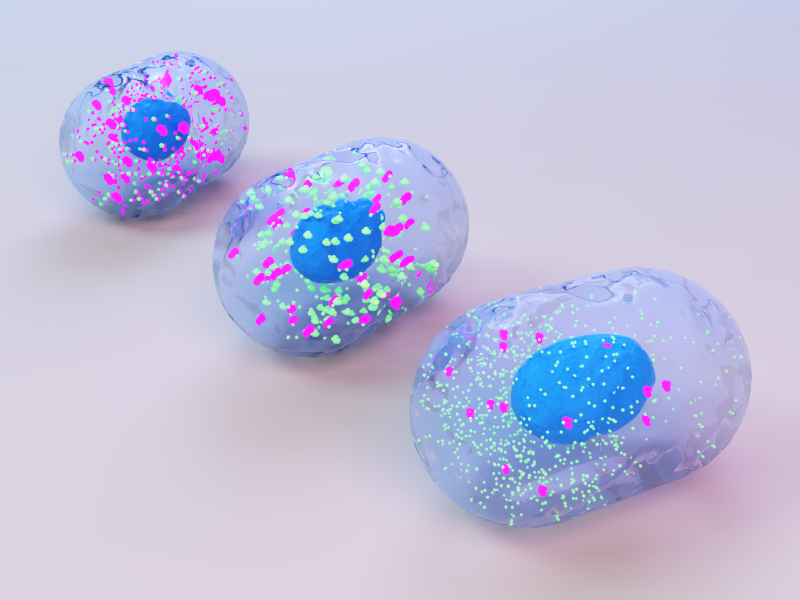
Breaking cell symmetry
A force driven mechanism for establishing cell polarity
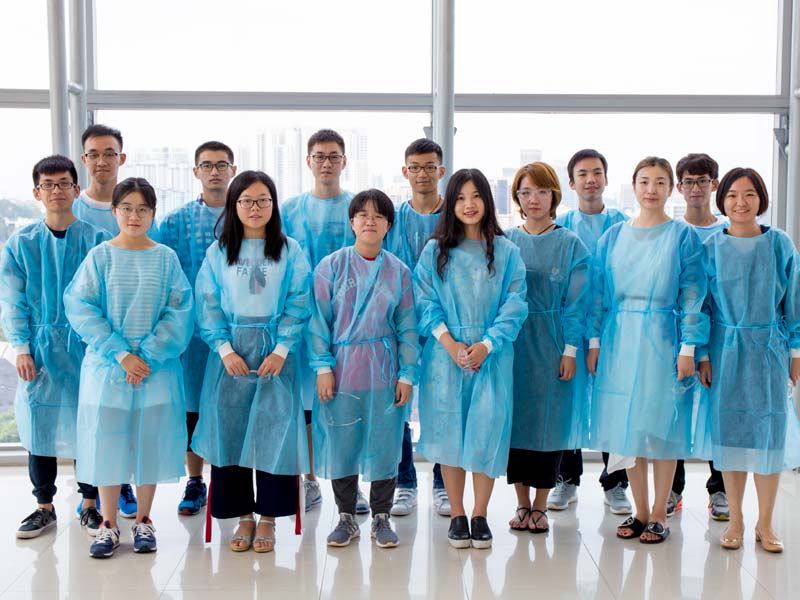
MBI welcomes students from Huazhong University of Science and Technology, China
On August 16th, a group of 13 students from the Huazhong University of Science and Technology (HUST), China visited the Mechanobiology Institute (MBI), National University of Singapore to learn more about scientific research in Singapore.
Yuan Luezhen
Alumni, Shivashankar Group

Dasvit Shetty
PhD Student, Class of August 2017, Yan Jie Group, Kenney Group

Toh Jia Ying Pearlyn
PhD Student, Class of August 2017, Saunders Group
Tricia Loo Yi Jun
PhD Student, Class of August 2017, Saunders Group
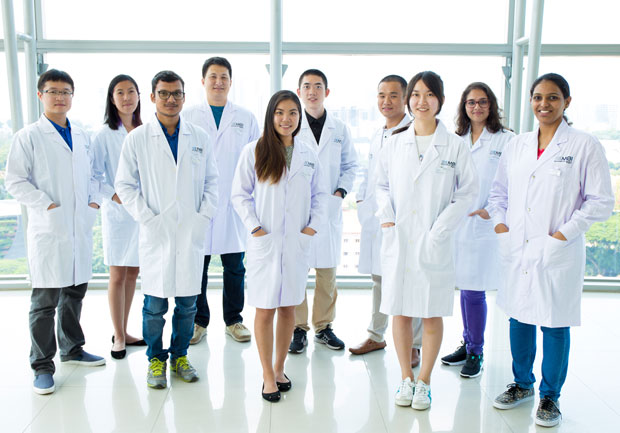
MBI welcomes our incoming class of August 2017
In August, 2017, MBI welcomes our latest incoming class of doctoral students, ten highly qualified candidates from schools both here in Singapore and abroad
Xu Yumeng
Alumni Class of August 2017, Yu Group

Paramasivam Kathirvel
Facility Manager, Shivashankar Group