

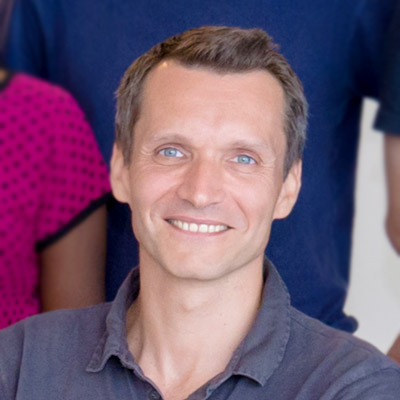
Benoit LADOUX
Visiting Faculty, Mechanobiology Institute, National University of Singapore, Research Director, Université Paris Diderot & Centre National de la Recherche Scientifique (CNRS)
Laboratory website
Cell Adhesion and Mechanics Lab
Research Program
Mechanotransduction in Tissues Group
Affiliations
Research Director, Université Paris Diderot & Centre National de la Recherche Scientifique (CNRS)
Mariana Barrera Velazquez
PhD Student, Class of August 2024, Dye Group
Lee Yuan Zhe
PhD Student, Class of August 2024, Hirashima Group
Le Thuy Truc Anh
PhD Student, Class of August 2024, Toyama Group

Kottpalli Vidhipriya
PhD Student, Class of August 2024, Young Group
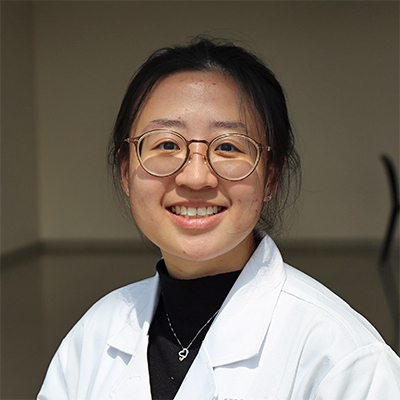
Goh Jia Lin Kellisa
PhD Student, Class of August 2024, Li Group
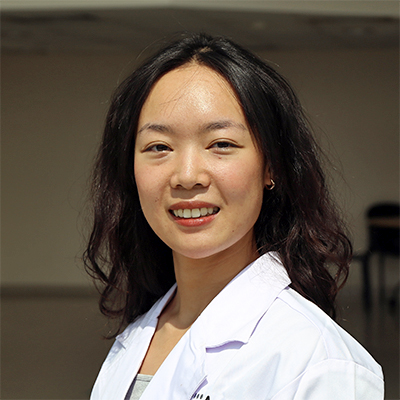
Cao Gefei
PhD Student, Class of August 2024, Hirashima Group, Chan Group
Benoit Ladoux
Visiting Faculty
Research Areas
Epithelial cell migration; microfabrication for cell mechanics; influence of the mechanical environments on cell functions; mechanotransduction
Research Interests
Our research aims at understanding how living organisms interact with their environment. In particular, we are studying the cooperation between adhesion, biomechanical and biochemical signaling for the adaptation of living organisms to changes in their environment. To probe these questions, our laboratory has developed a repertoire of micro- and nano-fabrication tools to control and measure the chemical and mechanical environment of cells. Our research programme thus focuses on the integration of novel microfabricated devices for the quantitative imaging of living organisms.
Biography
With a background in Physics, Prof Ladoux started his career at Curie Institute working on single molecule biophysics. He worked on two main problems combining statistical physics, microfabrication and molecular biology: 1) chromatin condensation in real time; 2) fluctuations of a single polymer under shear flows. After a post-doc on cell mechanics, he used his knowledge in biophysics and microfabrication to start a new subject on mechanical studies of cell migration and adhesion at the University Paris Diderot. He developed microsystems to characterise the mechanical interactions of cells with their migration support. He is currently working on rigidity sensing, collective cell migration and tissue homeostasis.
Recent Publications
- Shiratsuchi N, Fujita Y, Simon de Beco , Daubech C, Ladoux B, Grata A, Levayer R, Magny E, O'Brien LE, Priya R, Mitchell SJ, Rosenblatt J, Rupprecht J, Stockmann L, Sedzinski J, Roquin L, Suzanne M, Toyama Y, Matekcic M, Trepat X, Vinzens S, Wickström SA, Lwin AKO, and Yap AS. Meeting report - CellExIt#1, the first international symposium on cell extrusion. J Cell Sci 2026; 139(14). [PMID: 42504880]
- Balasubramaniam L, Monfared S, Ardaševa A, Rosse C, Schoenit A, Dang T, Maric C, Hautefeuille M, Kocgozlu L, Chilupuri R, Dubey S, Marangoni E, L Doss B, Chavrier P, Mège R, Doostmohammadi A, and Ladoux B. Dynamic forces shape the survival fate of eliminated cells. Nat Phys 2025;. [PMID: 40636322]
- Kawaue T, Yow I, Pan Y, Le AP, Lou Y, Loberas M, Shagirov M, Teng X, Prost J, Hiraiwa T, Ladoux B, and Toyama Y. Inhomogeneous mechanotransduction defines the spatial pattern of apoptosis-induced compensatory proliferation. Dev Cell 2023;. [PMID: 36800994]
- Sonam S, Balasubramaniam L, Lin S, Ivan YMY, Jaumà IP, Jebane C, Karnat M, Toyama Y, Marcq P, Prost J, Mège R, Rupprecht J, and Ladoux B. Mechanical stress driven by rigidity sensing governs epithelial stability. Nat Phys 2022; 19:132-141. [PMID: 36686215]
- Rose N, Estrada Chavez B, Sonam S, Nguyen T, Grenci G, Bigot A, Muchir A, Ladoux B, Cadot B, Le Grand F, and Trichet L. Bioengineering a miniaturized in vitro 3D myotube contraction monitoring chip to model muscular dystrophies. Biomaterials 2022; 293:121935. [PMID: 36584444]
- . https://www.ncbi.nlm.nih.gov/pubmed/36103541
- Yang Y, Nguyen E, Sankara Narayana GHN, Heuzé M, Fu C, Yu H, Mège R, Ladoux B, and Sheetz MP. Local contractions regulate E-cadherin rigidity sensing. Sci Adv 2022; 8(4):eabk0387. [PMID: 35089785]
- . https://www.ncbi.nlm.nih.gov/pubmed/33850145
- Latorre E, Kale S, Casares L, Gómez-González M, Uroz M, Valon L, Nair RV, Garreta E, Montserrat N, Del Campo A, Ladoux B, Arroyo M, and Trepat X. Addendum: Active superelasticity in three-dimensional epithelia of controlled shape. Nature 2021;. [PMID: 33846613]
- Balasubramaniam L, Doostmohammadi A, Saw TB, Narayana GHNS, Mueller R, Dang T, Thomas M, Gupta S, Sonam S, Yap AS, Toyama Y, Mège R, Yeomans JM, and Ladoux B. Author Correction: Investigating the nature of active forces in tissues reveals how contractile cells can form extensile monolayers. Nat Mater 2021;. [PMID: 33750921]
Lab Members
How does chromatin condensation keep the nucleus compact?
How does chromatin condensation keep the nucleus compact? Packaging of approximately a meter-long DNA duplex within the elastic nucleus determines its spatial 3D architecture and the genomic accessibility of tissue-specific transcriptional programs. Apart from [...]
How do chromosome territory dynamics affect gene redistribution?
How do chromosome territory dynamics affect gene redistribution? The spatial organization of chromatin within the 3-dimensional space of a chromosome territory enables the co-localization of co-transcribed genes and their transcriptional foci. Many gene positioning [...]
How does chromatin remodeling impact gene transcription?
How does chromatin remodeling impact gene transcription? While chromosome territory dynamics is believed to regulate gene expression through the redistribution of genes and the subsequent co-localization of these genes with transcription machinery, changes are [...]
How is transcription regulated in stem cells?
How is transcription regulated in stem cells? Pluripotent stem cells can potentially differentiate into any given cell type. They commonly exhibit mechanically softer nuclei [1], lack type-A lamins [2] and have a poorly defined [...]
What are transcription factories?
What are transcription factories? The primary role of chromatin assembly is the compaction of an otherwise very long DNA molecule into discrete structures that fit into the nucleus. However, this compaction cannot be achieved [...]
What is translation?
What is translation? Translation is a process that involves the synthesis of an amino acid chain from an mRNA blueprint. These polypeptide chains fold into functional proteins. Translation occurs outside the nucleus once nuclear [...]
How is DNA replicated?
How is DNA replicated? Cells must replicate their DNA before they can divide. This ensures that each daughter cell gets a copy of the genome, and therefore, successful inheritance of genetic traits. DNA replication [...]
How does the heart form?
How does the heart form? The heart is derived from the splanchnic lateral mesoderm and initially forms as two crescent-shaped endocardial plates inside the evolving pericardial cavity. As the embryo undergoes lateral and cranial [...]
Mechanobiology of bacterial pathogenesis
Bacterial Pathogenesis Pathogenesis is defined as the origination and development of a disease. Insights into disease etiology and progression, the two major aspects of pathogenesis, are paramount in the prevention, management and treatment of [...]
What are actin pedestals?
What are actin pedestals? Actin pedestals are raised actin structures formed by the dynamic polymerization of host actin, induced by effector proteins secreted by extracellular pathogens like Enteropathogenic Escherichia coli (EPEC) and Enterohaemorrhagic Escherichia [...]
What are septins?
What is the role of septins in infection? Host (human) septins play a role in bacterial pathogenesis [1] and in host defense mechanisms, mainly, autophagy [2]. Although actin is the most commonly exploited cytoskeletal [...]
What are telomeres?
What are telomeres? Telomeres are short nucleotide sequences found at the end of linear chromosomes which protect the genetic information. In vertebrates, telomeres have the hexameric sequence TTAGGG. During DNA replication, the double stranded [...]