


Kabir H BISWAS
Alumni, Mechanobiology Institute, National University of Singapore
mbikhb@nus.edu.sg
kabir.biswas@live.com
Level 09 T-Lab
National University of Singapore
5A Engineering Drive 1
Singapore 117411
Laboratory website
Kabir H Biswas Research
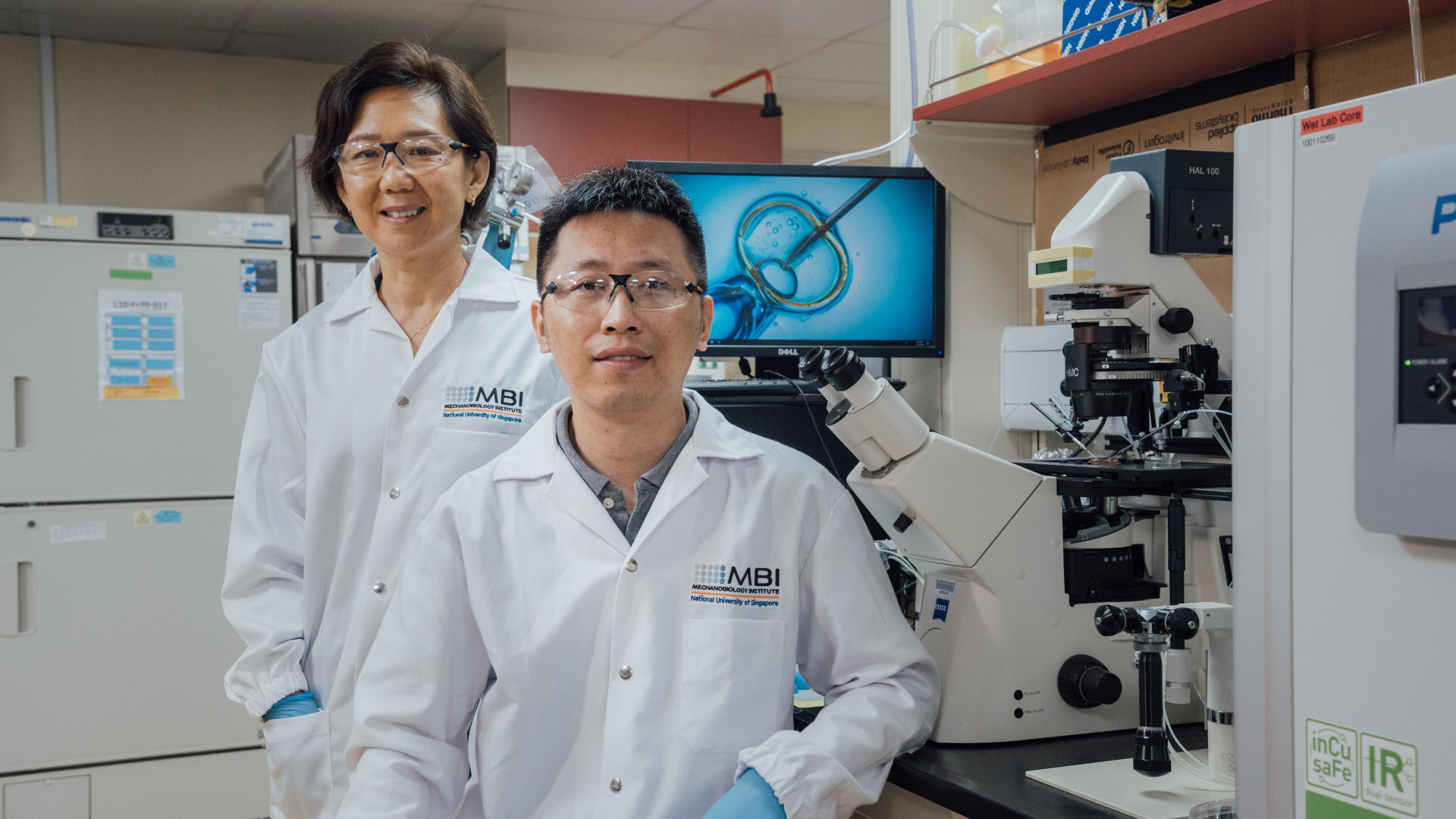
Rejuvenation of aged egg cells
MBI researchers collaborated with NUS Bia-Echo Asia Centre for Reproductive Longevity and Equality, based at the NUS Yong Loo Lin School of Medicine, to develop an innovative technique to significantly enhance the reproductive potential of aged oocytes, or immature egg cells, potentially paving the way for better outcomes of assisted reproductive technologies, such as in-vitro fertilisation (IVF), for older females. Learn more
Seeking Research Assistant in Cell Mechanics and Mechanobiology at the Mechanobiology Institute, NUS
We are seeking a Research Assistant in Cell Mechanics and Mechanobiology in the lab of Prof. Lim Chwee Teck at the Mechanobiology Institute, NUS.
Seeking Research Assistant in the labs of Dr. Natalie Dye and Dr. Alphée Michelot at the Mechanobiology Institute, NUS
We are seeking a Research Assistant to join the labs of Dr. Natalie Dye and Dr. Alphée Michelot at the Mechanobiology Institute, NUS.
Kabir H Biswas
MBI Alumni, June 2017
Principal Investigator
Research Interests
Molecular Mechanics of Mechanotransduction Group, Technology Innovation for Mechanobiology Group
Dr Biswas is interested in understanding mechanisms of cellular signal transduction mediated by cell membrane localized as well as cytosolic proteins. For instance, cells in a tissue receive both chemical (e.g. hormones or growth factors) as well as physical (e.g. mechanical tension or cell shape) cues that they need to appropriately process for both survival and growth of the whole organism. He believes that a comprehensive understanding of these processes in the cellular context will be useful in designing therapeutic strategies for alleviation of disease conditions.
Research Areas
Cell signaling, protein function regulation, cell adhesion, biomolecular assay development, biochemistry, biophysics, cell biology, bioinformatics
Biography
Dr Biswas joined the laboratory of Prof. Jay T Groves at the Mechanobiology Institute (MBI), National University of Singapore (NUS) as Research Fellow in December 2011. He has developed assays for E-cadherin adhesion, signaling and crosstalk with other receptors using synthetic, micropatterned membranes and has uncovered a novel, nucleation-dependent mechanism of adhesion formation. Prior to coming to Singapore, he was an Integrated PhD (MS + PhD) student at the Indian Institute of Science (IISc), Bangalore and worked with Prof Sandhya S. Visweswariah, Department of Molecular Reproduction, Development and Genetics (MRDG) towards his Masters as well as PhD thesis. There, he led a project that dealt on the possibility of multiple modes of allosteric regulation of proteins that are involved in cyclic-guanosine monophosphate (cGMP) signal transduction pathway such as guanylyl cyclases and cGMP phosphodiesterases.
Education
PhD Indian Institute of Science
Current Projects
E-cadherin junction formation involves an active kinetic nucleation process
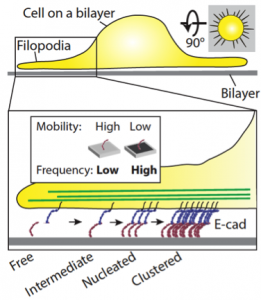 Biswas KH, Hartman KL, Yu C-h, Harrison OJ, Song H, Smith AW, Huang WYC, Lin W-C, Guo Z, Padmanabhan A, Troyanovsky SM, Dustin ML, Shapiro L, Honig B, Zaidel-Bar R, Groves JT (2015) Proc Natl Acad Sci U S A 112(35):10932-7
A schematic representation of E-cadherin junction formation on a supported lipid bilayer. Cells seeded on a bilayer interact with E-cadherin by extending and retracting filopodia. Retracting filopodia increases the local concentration of interacting E-cadherin molecules on high viscosity, low mobility bilayers. This process most often fails on low viscosity, high mobility bilayers due to faster diffusive dissipation of E-cadherin molecules.
Distinct Allostery Induced in the Cyclic GMP-binding, Cyclin GMP-specific Phosphodiesterase (PDE5) by Cyclic GMP, Sildenafil and Metal Ions
 Biswas KH and Visweswariah SS (2011) J Biol Chem 286(10):8545-54
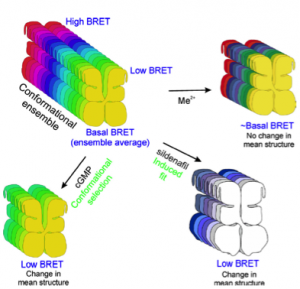
Conformational transitions in PDE5. An ensemble of conformations of PDE5 can exist, with a spectrum of BRET, and the basal BRET being the average. Cyclic GMP selectively binds the low BRET conformers shifting the equilibrium toward reduced average BRET. Sildenafil induces conformational changes in the protein which require high activation energy resulting in a reduction in BRET. A change in the mean structure of the protein occurs in both the cases. Metal ions binding to the catalytic site alter the dynamics of the protein without causing any considerable change in the mean structure. Sequential binding of sildenafil and cGMP, and vice versa, further changes the mean structure of the protein, which for simplicity, is not depicted in the figure. Metal ion binding to the catalytic site reverts the cGMP-bound low BRET conformers to ~basal BRET conformers. In contrast, metal ion binding to the catalytic site enhances sildenafil-induced reduction in BRET.
Recent Publications
Publications
- Vafaei S, Tabaei SR, Biswas KH, Groves JT, and Cho N. Dynamic Cellular Interactions with Extracellular Matrix Triggered by Biomechanical Tuning of Low-Rigidity, Supported Lipid Membranes. Adv Healthc Mater 2017;. [Accepted] [PMID: 28371558]
- Biswas KH* and Viswesweriah SS* (2017) Buffer NaCl concentration regulates Renilla luciferase activity and ligand-induced conformational changes in the BRET-based PDE5 sensor Matters [Accepted] [PMID: awaited]
- Biswas KH* (2017) Allosteric regulation of proteins: a historical perspective on the development of concepts and techniquesResonance 22(1): 37-50 [PMID: not available]
- Biswas KH*, and Zaidel-Bar R*. Early events in the assembly of E-cadherin adhesions. Exp. Cell Res. 2017;. [PMID: 28237244]
- Biswas KH*, Hartman KL, Zaidel-Bar R*, and Groves JT*. Sustained α-catenin Activation at E-cadherin Junctions in the Absence of Mechanical Force. Biophys. J. 2016; 111(5):1044-52. [PMID: 27602732]
- Biswas KH*, and Groves JT*. A Microbead Supported Membrane-Based Fluorescence Imaging Assay Reveals Intermembrane Receptor-Ligand Complex Dimension with Nanometer Precision. Langmuir 2016; 32(26):6775-80. [PMID: 27264296]
- Yu C, Rafiq NBM, Cao F, Zhou Y, Krishnasamy A, Biswas KH, Ravasio A, Chen Z, Wang Y, Kawauchi K, Jones GE, and Sheetz MP. Integrin-beta3 clusters recruit clathrin-mediated endocytic machinery in the absence of traction force. Nat Commun 2015; 6:8672. [PMID: 26507506]
- Biswas KH, Hartman KL, Yu C, Harrison OJ, Song H, Smith AW, Huang WYC, Lin W, Guo Z, Padmanabhan A, Troyanovsky SM, Dustin ML, Shapiro L, Honig B, Zaidel-Bar R, and Groves JT. E-cadherin junction formation involves an active kinetic nucleation process. Proc. Natl. Acad. Sci. U.S.A. 2015; 112(35):10932-7. [PMID: 26290581]
- Biswas KH*, Badireddy S, Rajendran A, Anand GS and Viswesweriah SS* (2015) Cyclic nucleotide binding and structural changes in the isolated GAF domain of Anabaena adenylyl cyclase, CyaB2PeerJ 3:e882; DOI 10.7717/peerj.882 [PMID: 25922789]
* co-corresponding author