
How do nascent adhesions grow into mature focal adhesions?
How do nascent adhesions grow into mature focal adhesions? Nascent adhesions undergo a transient phase of rapid assembly and disassembly through which a fraction of adhesions survive to evolve into more stable and larger [...]
What is the role of Rho GTPases in the regulation of focal adhesion assembly?
What is the role of Rho GTPases in the regulation of focal adhesion assembly? Synergistic integrin-syndecan signaling The rate and extent of focal adhesion formation and maturation are regulated by factors such as synergistic [...]
What steps are involved in the formation of focal adhesions?
What steps are involved in the formation of focal adhesions? The assembly of focal adhesions is highly regulated, with protein recruitment occurring in a sequential manner [1], and resulting in structures that are organized [...]
What are actin filaments?
What are actin filaments? Actin filaments (F-actin) are linear polymers of globular actin (G-actin) subunits and occur as microfilaments in the cytoskeleton and as thin filaments, which are part of the contractile apparatus, in [...]
What is the cytoskeleton?
What is the Cytoskeleton? The eukaryotic cytoskeleton is a network of three long filament systems, made from the repetitive assembly and disassembly of dynamic protein components. The primary filament systems comprising the cytoskeleton are [...]
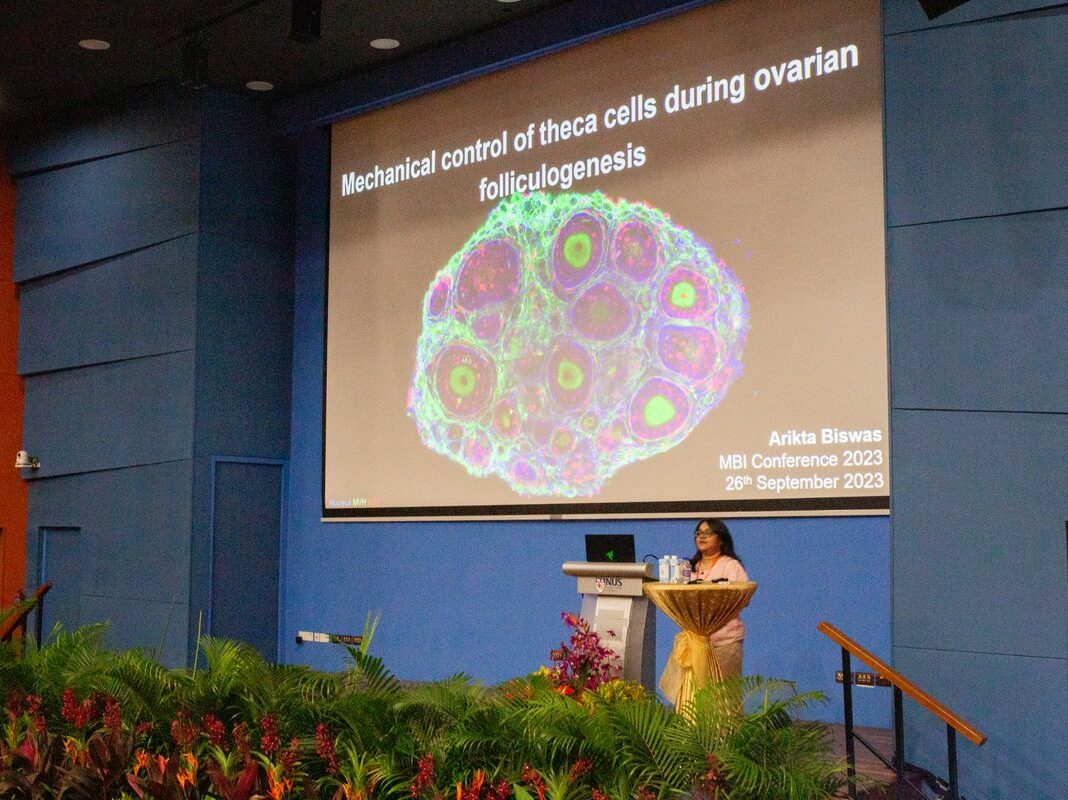
Arikta and Yuting shared their research as speakers at the MBI Conference 2023
Congratulations to Arikta and Yuting for being selected as speakers and sharing their latest research on ovarian folliculogenesis in MBI Conference 2023: Mechanobiology in Health and Disease. Thanks to various feedback following the talks!
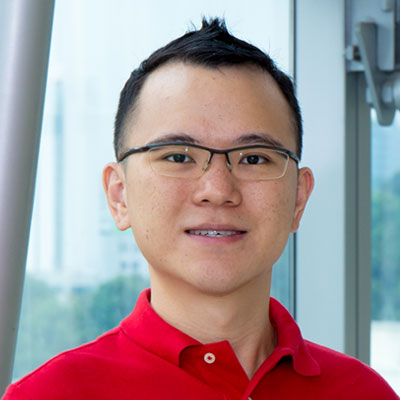
Ding Wei Yung
Alumni
Principal Investigator
Research Interests
Cell-Matrix and Cell-Cell Mechanotransduction, Molecular Mechanisms of Mechanobiology
Wei Yung’s interest lies in understanding the sophistication of cells as robust machines. Using C. elegans, a 1mm nematode, as a model system, he investigates the cellular machinery underlying newly fertilized zygotes that drives critical force-dependent processes such as polarization and cytokinesis.
Biography
Wei Yung completed his Bachelor’s degree in Bioengineering (Second Class Upper) from the National University of Singapore in 2012. In his honors dissertation under the co-supervision of Professor James Goh and Professor Wong Hee Kit, he optimized the conditions required for the construction of interbody spinal fusion device using primary adipose stem cells seeded in a biodegradable polycaprolactone/tricalcium sulphate (PCL/TCP) scaffold. The work was presented in the Bioengineering Showcase 2012 and he was awarded the Best Poster Award. After he was enrolled in the Mechanobiology Graduate Program, he joined Dr. Zaidel-Bar’s Cell Adhesion and Morphogenesis Lab and is currently searching for novel genes involved in regulating C. elegans early embryogenesis.