

What steps are involved in Lamellipodia assembly?
What steps are involved in Lamellipodia assembly? The lamellipodia is a distinct region of the cell that facilitates cell motility and various mechanosensing mechanisms. Lamellipodium assembly can be described in a series of defined [...]
How does nucleation of actin initiate lamellipodia formation?
How does nucleation of actin initiate lamellipodia formation? In the first phase of lamellipodia formation, actin filament polymerization produces a protrusive force on the cell membrane that promotes the spreading out and enlargement of [...]
What mechanisms drive extension, pause and stasis of the lamellipodia?
What mechanisms drive extension, pause and stasis of the lamellipodia? Extension of the newly formed actin filament branches occurs at the interface between the leading edge and the existing actin filament network [1] and [...]
How do focal adhesions act as molecular clutches in lamellipodia?
How do focal adhesions act as molecular clutches in lamellipodia? Once formed, focal adhesions essentially act as “molecular clutches”, promoting protrusion at the leading edge whilst suppressing membrane contraction (reviewed in [1] [2][3]). Adhesions [...]
How does force generation within lamellipodia facilitate cell translocation?
How does force generation within lamellipodia facilitate cell translocation? Interactions between actin filament networks and the focal adhesions to which they are linked results in the generation of forces. These forces may be exerted [...]
What mechanisms drive retraction of the trailing edge?
What mechanisms drive retraction of the trailing edge? Protrusion at the front and retraction at the rear are key force-generating processes at the cell periphery that culminate in the translocation of the cell. For [...]
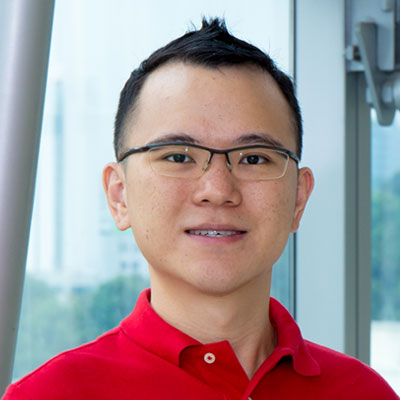
Ding Wei Yung
Alumni
Principal Investigator
Research Interests
Cell-Matrix and Cell-Cell Mechanotransduction, Molecular Mechanisms of Mechanobiology
Wei Yung’s interest lies in understanding the sophistication of cells as robust machines. Using C. elegans, a 1mm nematode, as a model system, he investigates the cellular machinery underlying newly fertilized zygotes that drives critical force-dependent processes such as polarization and cytokinesis.
Biography
Wei Yung completed his Bachelor’s degree in Bioengineering (Second Class Upper) from the National University of Singapore in 2012. In his honors dissertation under the co-supervision of Professor James Goh and Professor Wong Hee Kit, he optimized the conditions required for the construction of interbody spinal fusion device using primary adipose stem cells seeded in a biodegradable polycaprolactone/tricalcium sulphate (PCL/TCP) scaffold. The work was presented in the Bioengineering Showcase 2012 and he was awarded the Best Poster Award. After he was enrolled in the Mechanobiology Graduate Program, he joined Dr. Zaidel-Bar’s Cell Adhesion and Morphogenesis Lab and is currently searching for novel genes involved in regulating C. elegans early embryogenesis.