


Natalie DYE
Assistant Professor, Mechanobiology Institute, National University of Singapore
ndye@nus.edu.sg
09-03-05
Level 9 T-Lab
National University of Singapore
5A Engineering Drive 1
Singapore 117411
Affiliations
Department of Biomedical Engineering, National University of Singapore
Natalie Dye
Principal Investigator
Research Areas
Tissue morphogenesis, collective cell dynamics in epithelia, regulation of tissue growth, cell signalling, cell polarity, 3D tissue architecture and self-organization
Research Interests
How cellular activity is coordinated over long spatial and temporal timescales to robustly build complex 3D tissue morphologies remains a fascinating open topic in biology. In my group, we study this question using the Drosophila wing and human organoid model systems, striving to uncover fundamental mechanisms for collective cell organization that are relevant for both development and disease. To do so, we dynamically image and quantify cellular behavior, develop theoretical models in collaboration with physicists, and design genetic and mechanical experiments to test such models.
Education
B.Sc., Biochemistry with High Honors in Cell Biology and Molecular Genetics, University of Maryland, College Park, USA
PhD, Biochemistry, Stanford University, USA
Biography
Natalie Dye was trained in biochemistry and cell biology at the University of Maryland and Stanford University, USA. During her PhD research, she was advised by Dr. Julie Theriot and Dr. Lucy Shapiro, working on how a bacterial cell maintains its shape using the bacterial actin MreB. For her postdoc research, she continued on the theme of morphology but moved to the level of cells-to-tissues to study epithelial growth and morphogenesis using the Drosophila wing model, working in the lab of Dr. Suzanne Eaton at the Max Planck Institute for Cell Biology and Molecular Genetics in Dresden, Germany. During this time, she developed methods for long-term live imaging and quantification of cell dynamics in wing disc explants during growth and morphogenesis that led to new models for how oriented tissue growth can be regulated. In 2021, she became an independent group leader at the DFG Cluster of Excellence, Physics of Life, at TU-Dresden, and expanded her research to look into self-organized dynamic behavior of human cells in culture. In 2024, she moved to the Mechanobiology Institute and Biomedical Engineering departments at NUS.
Selected Publications
- Fuhrmann JF, Krishna A, Paijmans J, Duclut C, Cwikla G, Eaton S, Popovic M, Julicher F, Modes CD, Dye NA*. Active shape programming drives Drosophila wing disc eversion. Science Advances 2024. https://doi.org/10.1126/sciadv.adp0860
- Piscitello-Gomez R, Gruber FS, Krishna A, Duclut C, Modes CD, Popovic M, Julicher F, Dye NA*, and Eaton, S. Core PCP mutations affect short time mechanical properties but not tissue morphogenesis in the Drosophila pupal wing. Elife 2023. https://doi.org/10.7554/eLife.85581.
- Nellas I, Iyer KV, Iglesias-Artola JM, Pippel M, Nadler A, Eaton S, Dye NA*. Hedgehog signaling can enhance glycolytic ATP production in the Drosophila wing disc. Embo Reports 2022. https://doi.org/10.15252/embr.202154025
- Dye NA*. Cultivation and live imaging of Drosophila imaginal discs. 2022. In: Dahmann, C. (eds) Drosophila. Methods in Molecular Biology, vol 2540. Humana, New York, NY. https://doi.org/10.1007/978-1-0716-2541-5_16.
- Dye NA*, Popovic M, Iyer V, Fuhrmann JF, Piscitello-Gómez R, Eaton S, Jülicher F. Self-organized patterning of cell morphology via mechanosensitive feedback. Elife. 2021. https://doi.org/10.7554/eLife.57964
- Mateus R, Fuhrmann JF, Dye NA*. Growth across scales: Dynamic signaling impacts tissue size and shape. Current Opinion Cell Biology 2021. https://doi.org/10.1016/j.ceb.2021.05.002.
- Spannl S, Buhl T, Ahmed SK, Nellas I, Iyer KV, Khaliullina H, Schultz C, Nadler A, Dye NA*, Eaton S. Cell metabolism influences Hedgehog signaling in the Drosophila wing disc. EMBO J. 2020. https://doi.org/10.15252/embj.2019101767.
- Dye NA*, Popovic M, Spannl S, Etournay R, Kainmueller D, Ghosh S, Myers G, Jülicher F, Eaton S. Cell dynamics underlying oriented growth of the Drosophila imaginal wing disc. Development. 2017. https://doi.org/10.1242/dev.155069
Full publication list available at Google Scholar
Lab Members

Piyush Amitabh
Research Fellow, Dye Group

P. Shakthi
Research Assistant, Dye & Michelot Groups

Geetika Chouhan
Research Fellow, Dye Group
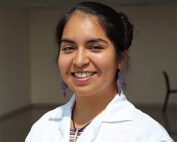
Mariana Barrera Velazquez
PhD Student, Class of August 2024, Dye Group