

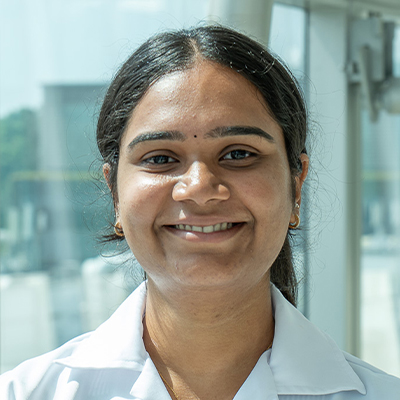
Sudha MERLA
PhD Student, Mechanobiology Institute, National University of Singapore
sudha.merla@u.nus.edu
Level 10 T-Lab
National University of Singapore
5A Engineering Drive 1
Singapore 117411
Sudha MERLA
PhD Student
Background
Sudha Merla is a PhD student at the Mechanobiology Institute (MBI), NUS. She completed her Bachelor of Science with an Honours degree in Genetics from Dayananda Sagar University, India, in 2026. During her undergraduate studies, she conducted research at the SynTech BioSolutions Laboratory under the guidance of Dr. Pronama Biswas and Dr. B. M. Ashwin Desai, where she worked on the extraction of plant-derived biomaterials and the development of electrospun nanofibrous biomaterials for wound healing. She also completed a Summer Research Fellowship at BRIC-inStem, investigating the effects of a novel therapeutic compound on intestinal stem cell proliferation using the Drosophila model. Her research interests focus on interdisciplinary science, integrating biomaterials, regenerative medicine, and computational biology with experimental and computational approaches to advance tissue repair and regenerative therapies.
Research Interests
Biomaterials, regenerative medicine, and computational biology, with a focus on designing functional biomaterials for tissue repair through the integration of molecular modeling, computational analysis, and experimental approaches to understand cell–material interactions and develop innovative therapeutic strategies.
Recent Publications
- Biswas, P., Shanbhog, S., Sudha, M., & Ashwin Desai, B. M. (2025). Advancing Alzheimer’s disease treatment: Synergistic ligand combinations targeting BACE1 through multi-ligand simultaneous docking. Advanced Neurology, 0(0), 025190052. https://doi.org/10.36922/AN025190052
- Biswas, P., Sridhar, B., Saha, A., Sudha, M., & Kulkarni, M. (2026). The Role of Epigenetics in Cancer Progression. In Cancer Targets: Novel Therapies and Emerging Research Directions (Part 1) (pp. 69–130). BENTHAM SCIENCE PUBLISHERS. https://doi.org/10.2174/9798898814113126010006
- Biswas, P., Sudha, M., Agarwal, K., Bhatt, M., Sridhar, B., & Desai, B. M. A. (2025). Current Updates on Photoacoustic-Based Techniques for Breast Cancer Diagnosis (pp. 373–423). https://doi.org/10.1007/978-3-031-94551-9_16
- Desai, B. M. A., Sudha, M., Ghosh, S., & Biswas, P. (2024a). Prediction of Novel CXCR7 Inhibitors Using QSAR Modeling and Validation via Molecular Docking. 2024 First International Conference for Women in Computing (InCoWoCo), 1–5. https://doi.org/10.1109/InCoWoCo64194.2024.10863533
- Ghosh, S., Sudha, M., Prajwal RS, R., A Nadaf, S., RS, S., Biswas, P., & Desai, B. M. A. (2024). Development of Poly-vinyl alcohol (PVA) and Moringa oleifera-based nanofibre patches for wound healing using an indigenous electrospinning setup. Manipal Journal of Science and Technology, 9(1).
- Sridhar, B., Sudha, M., Ghosh, S., Desai, B. M. A., & Biswas, P. (2026). Biomedical Applications and Toxicity Mitigation of Functional Quantum Dots (pp. 61–107). https://doi.org/10.1007/978-3-031-98219-4_4
- Sudha, M., Saha, A., Desai, B. M. A., Mhashal, A. R., & Biswas, P. (2025). Multi-ligand simultaneous docking of Carica papaya leaf phytochemicals, Carpaine and Rutin reveal multi-mechanism inhibition of cancer proteins, BCL-2 and WWP1. Phytomedicine Plus, 5(3), 100829. https://doi.org/10.1016/j.phyplu.2025.100829